
 Business License
Gear Coupling for Steel Mill Applications: A Selection Guide
In February 2026, Tomasz, a maintenance manager at a Polish mini-mill in Silesia, watched the roughing mill stop mid-campaign. The gear coupling between the main motor and gearbox had stripped its teeth in a single bite impact. The coupling had been sized on nominal motor torque two years earlier, and nobody had accounted for the shock loads that arrive every time the rolls bite a slab. The unplanned repair consumed 26 hours of prime production.
Choosing a gear coupling for steel mill duty means designing for the shock, not the average. If you maintain rolling mills, casters, or mill cranes, you already know that a steel plant punishes every component in the drive line. The coupling absorbs that punishment first.
This guide explains why steel mill conditions are uniquely severe, which coupling types survive them, and how to size a gear coupling for steel mill applications correctly. As a manufacturer supplying couplings to steel and metallurgy operations worldwide, Hebei Suju works with these drives daily, and this guide reflects that experience.
Why Steel Mills Demand More from a Gear Coupling
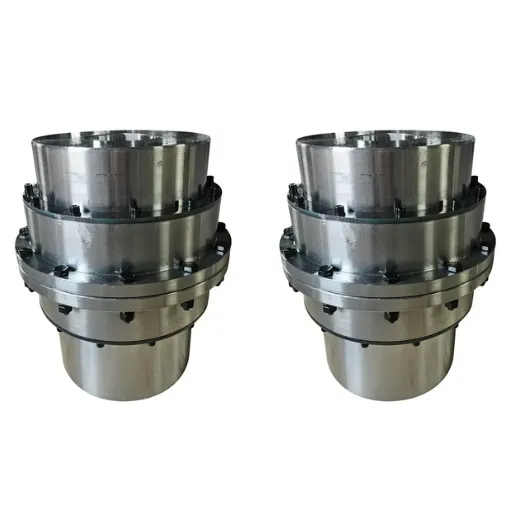
A steel mill combines four conditions that each shorten coupling life on their own. Together, they eliminate any margin for selection error.
Shock loads from bite impact. Every time the rolls grip a slab or billet, torque spikes far above the nominal value. Roughing and blooming mills see these spikes hundreds of times per shift, and the coupling transmits every one.
Heat and thermal growth. Drives near the mill line operate beside steel at 1,000°C or more. Shafts grow, foundations shift, and alignment drifts between cold startup and hot rolling.
Scale, dust, and moisture. Mill scale and descaling water attack seals and lubricant. A coupling that runs clean in a machine shop degrades quickly beside a caster.
Reversing and continuous duty. Many mill drives reverse every pass, and the plant runs around the clock. Fatigue accumulates fast, and there is no idle window for improvised repairs.
The economics raise the stakes further. On a hot rolling line, an unplanned stop cascades: the furnace keeps burning fuel, the caster queue backs up, and the campaign schedule slips. Experienced mills respond by specifying couplings conservatively and holding critical spares on site.
A gear coupling for steel mill service must be selected against all four conditions at once, which is why the sizing method below starts with shock rather than with power.
Which Gear Coupling Types Work in a Steel Mill
Three drum gear coupling series cover most steel mill drives, and each answers a different structural need.
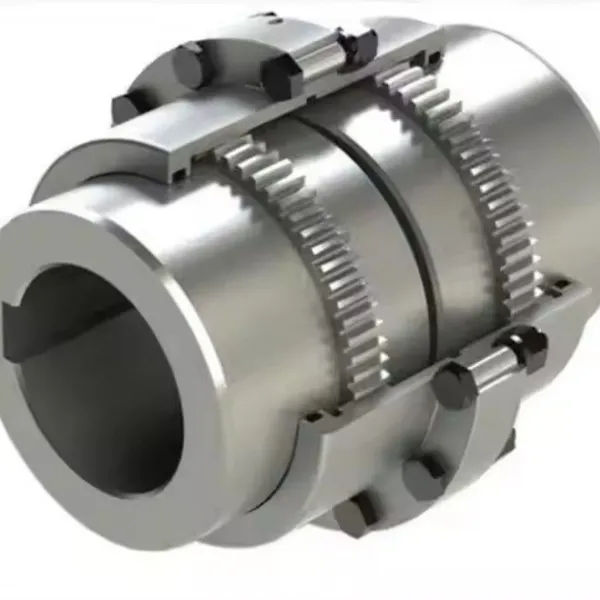
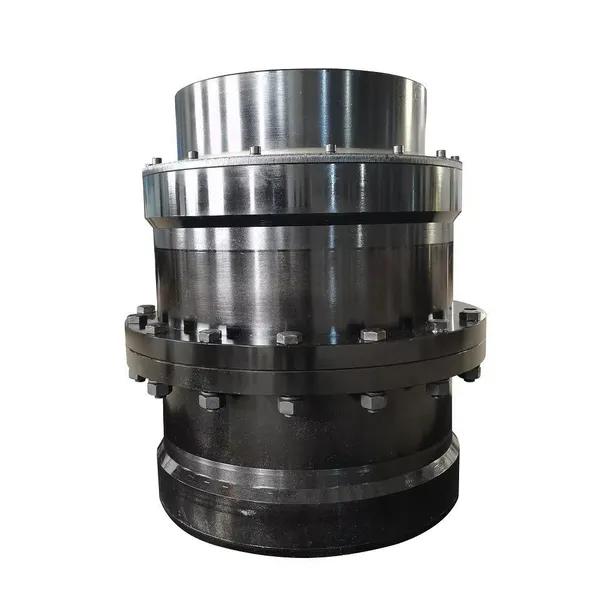
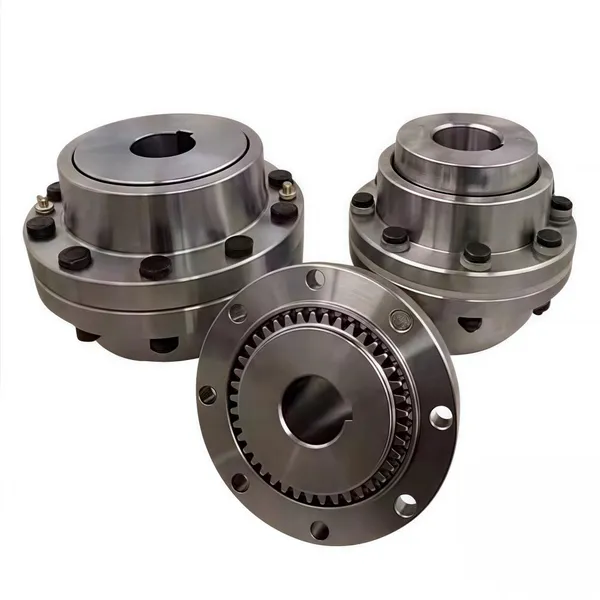
GIICL drum gear couplings are the compact, general-purpose choice for mill stands, roller tables, shears, and auxiliary drives. They handle high torque and compensate for angular, radial, and axial misalignment. The GIICL drum gear coupling specifications guide covers the full rating tables.
NGCL drum gear couplings add an integrated brake wheel, making them the standard choice for ladle cranes, charging cranes, and hoists where the brake acts on the coupling.
WGT drum gear couplings insert a removable intermediate sleeve, ideal for runout tables and drives where machines cannot move for maintenance.
For the heaviest main drives, such as roughing mill spindles, a cardan shaft often replaces the gear coupling entirely because it tolerates larger angles and simplifies roll changes. Roughing and blooming rolling mills often exceed 100,000 N·m at the spindle, and at that scale universal-joint cardan shafts handle the angle changes of roll gap adjustment better than any tooth coupling. The gear coupling still owns the motor-to-gearbox connection in these drives.
Hebei Suju manufactures all three series, machined from forged alloy steel with heat-treated teeth and optional dynamic balancing for high-speed drives.
How to Size a Gear Coupling for Steel Mill Duty
Sizing follows five checks, in the order that prevents the most failures.
1. Start with Shock: Service Factor Before Power
Nominal torque from motor power and speed is only the baseline. Steel mill applications carry some of the highest service factors in industry because of bite impact and reversing duty.
| Mill Application | Duty Character | Suggested Service Factor |
|---|---|---|
| Roughing / blooming mill | Severe shock, reversing | 2.5-3.0 |
| Finishing mill stands | Moderate shock | 2.0-2.5 |
| Roller and runout tables | Frequent starts, moderate | 1.75-2.25 |
| Shears and cut-off machines | Severe shock | 2.5-3.0 |
| Coil handling cranes and hoists | Frequent reversing | 2.0-2.5 |
| Descaling pumps and fans | Uniform to moderate | 1.5-1.75 |
Multiply nominal torque by the service factor, then select a size whose rated torque meets or exceeds the result. Guidance from the American Gear Manufacturers Association and manufacturer catalogs provides application-specific values. Our guide on how to select a gear coupling for heavy machinery walks through the full calculation.
2. Check Peak Torque, Not Just Continuous Torque
Bite impact and emergency stops generate peak torque that can reach two to three times nominal. Verify that the coupling's allowable peak torque covers the highest credible spike, not just the adjusted continuous value. This is the check Tomasz's predecessor skipped in Silesia.
3. Measure Misalignment at Operating Temperature
Alignment measured cold on a drawing tells half the story. Shafts and foundations move as the mill heats up, so estimate angular, radial, and axial misalignment in the hot condition. Select a size whose compensation exceeds the hot values, not the cold ones.
4. Verify Speed and Balance
Most mill drives run well below coupling speed limits, but high-speed finishing and descaling drives can approach them. For operation near the limit, specify dynamic balancing to the appropriate ISO grade to control vibration and protect bearings.
5. Confirm Bores, Keyways, and Environment
Confirm both shaft diameters and keyway dimensions against the hub bore range. Then specify sealing and lubrication for the environment: sealed gear meshes with appropriate grease retention for dusty, wet positions beside the mill line.
Matching Coupling Choices to Common Steel Mill Locations
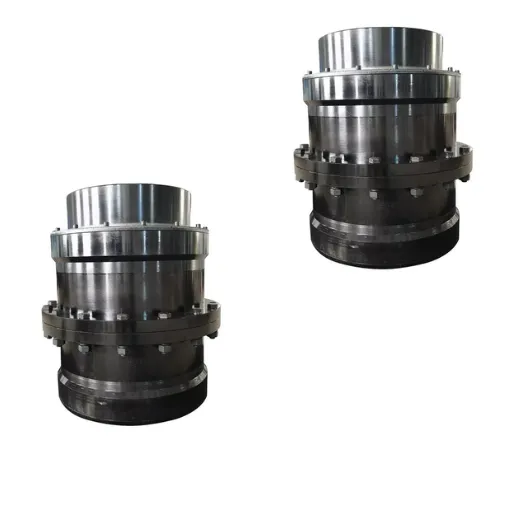
The right series depends on where the coupling sits in the plant. This table summarizes typical choices.
| Mill Location | Typical Coupling | Deciding Factor |
|---|---|---|
| Roughing mill main drive | Heavy drum gear or cardan shaft | Extreme torque and shock |
| Finishing stands | GIICL drum gear | Torque plus misalignment |
| Runout and roller tables | WGT spacer type | Maintenance access, long spans |
| Ladle and charging cranes | NGCL brake wheel type | Braking acts on the coupling |
| Shears and saws | GIICL, high service factor | Shock absorption |
| Descaling pumps | Flexible or GIICL | Speed and environment |
One practical rule: if the drive is critical to the rolling campaign, choose the coupling one size above the calculated minimum when space and cost allow. The modest price difference is cheap insurance against a mid-campaign failure. Experienced mills apply the same logic to spares: holding one coupling on the shelf for each critical drive turns a multi-day procurement delay into a same-shift replacement.
Budi, a maintenance supervisor at an Indonesian billet mill, applied this rule to a caster drive that had eaten two couplings in eighteen months. His recalculation with a 2.5 service factor moved the drive from the calculated size to one size up, and he specified the bores for the hot-measured misalignment. His team shared the measurement data with the coupling supplier, so the replacement was manufactured to verified dimensions rather than catalog assumptions. The replacement gear coupling for steel mill duty has now run through two full campaigns without a forced stop.
Materials, Heat Treatment, and Quality Control
In a steel mill, material quality is not a marketing point; it is the difference between a coupling that fatigues in months and one that lasts for years. Hebei Suju machines gear coupling hubs and sleeves from 42CrMo or equivalent forged alloy steel, then hardens the teeth by induction hardening or carburizing for wear resistance under shock loading.
Production follows a controlled sequence: forging or bar-stock preparation, rough machining, heat treatment, finish machining of bores and tooth profiles, and final inspection. Each stage is documented, so the hardness value on your certificate traces back to a specific furnace batch.
Every coupling passes dimensional inspection, hardness testing, and surface finish verification before packing. Dynamic balancing is available for high-speed positions, and inspection reports and material certificates ship with the product on request.
Lubrication and Maintenance in Steel Mill Service
A correctly sized coupling still fails early without lubrication discipline. In steel mill service, three practices matter most.
Use the manufacturer-specified grease. Gear couplings need adhesive, extreme-pressure grease that stays in the mesh under centrifugal load. Substituting general-purpose grease is a slow-motion failure.
Shorten relubrication intervals near the mill line. Heat and scale contamination degrade grease faster than catalog intervals assume. Positions beside hot rolling lines often need relubrication at half the standard interval.
Inspect during planned shutdowns. Check tooth wear, backlash growth, seal condition, and bolt torque at every planned stop. Track backlash measurements over time, because a rising trend predicts failure months in advance and lets you schedule the replacement instead of suffering it.
These practices cost little and directly address the contamination and fatigue mechanisms that end most steel mill coupling lives.
Common Mistakes When Specifying a Gear Coupling for Steel Mill Duty
Most steel mill coupling failures trace back to a short list of selection errors. Avoid these mistakes.
Sizing on nominal torque alone. Without the shock service factor, teeth fatigue and strip under bite impact.
Ignoring peak torque. Continuous ratings do not protect against emergency-stop and bite spikes.
Measuring alignment cold. Hot misalignment exceeds cold measurements, sometimes by several millimeters across a long drive.
Replacing like-for-like without root cause analysis. A European mini-mill replaced a failed roughing coupling with the identical size twice in one year. The third replacement, upsized after a proper failure review, ended the cycle. The failure was a selection problem, not a manufacturing problem.
Neglecting sealing and lubrication. Mill scale in the grease destroys teeth faster than overload does.
Each mistake shares one root cause: treating a steel mill as a normal industrial environment. It is not, and the coupling specification must say so.
When You Need a Custom Gear Coupling for a Steel Mill
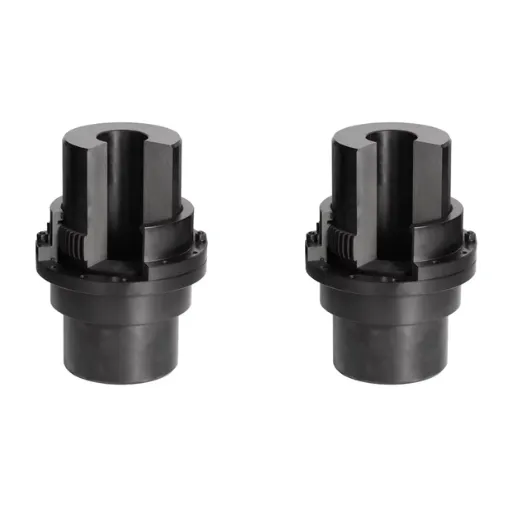
Catalog sizes cover most mill drives, but custom couplings are common for legacy mills whose original suppliers no longer exist, non-standard shaft layouts, and extreme environments that need special materials or coatings.
At Hebei Suju, drawing-based customization is a core service. Send the original drawing or a worn sample, and our engineers verify dimensions, recommend materials and heat treatment, and quote a coupling matched to your drive. Single pieces and small batches are routine production, which matters when a mill cannot wait for a large minimum order.
Delivery speed matters as much as dimensional accuracy during a shutdown. Our integrated factory and local logistics network support urgent production for outage windows, and every quotation states a clear lead time so your planner can commit the shutdown slot with confidence.
Conclusion
A gear coupling for steel mill service succeeds or fails on how it handles shock, heat, contamination, and reversing duty together. The key points:
Size with the service factor first, using 2.5-3.0 for severe shock positions such as roughing mills and shears.
Check peak torque and hot-condition misalignment, not just catalog continuous ratings.
Match the series to the location: GIICL for mill drives, NGCL for cranes, WGT for long spans.
Specify hardened alloy steel teeth, sealed lubrication, and verified quality documentation.
Whether you are replacing a failed coupling or specifying a new mill drive, Hebei Suju can help you confirm every rating before production. Request a quotation with your application data, or send us your drawing for a free engineering review of a custom gear coupling for steel mill duty.
Recently Posted
-
Jaw Coupling Spider Replacement: A Step-by-Step Maintenance Guide
July 28, 2026A maintenance technician at a packaging plant in Brazil noticed vibration on a motor-pump set during his morning rounds. The motor Read More
 -
Flexible Coupling for Motor Pump Sets: A Selection Guide
July 28, 2026A maintenance manager at a water treatment plant in Southeast Asia called us after replacing motor pump couplings three times in 1 Read More
 -
Flexible Shaft Coupling: Selection Guide for Industrial Drives
July 28, 2026When two rotating shafts are connected directly, even a small amount of misalignment can generate vibration, bearing load, and pre Read More
 -
Elastic Coupling: Vibration Control for Industrial Drives
July 28, 2026When a motor-pump set starts vibrating above acceptable limits, the first checks usually fall on bearing wear, impeller balance, o Read More

Contact Us
Recommended Products
-
 OEM Customizable Cardan Shaft Coupling Flexible Rigid Steel for Air Compressor Propeller Universal Construction Printing ShopsNegotiableMOQ: 2 Pieces
 -
Kc Coulpling Roller Chain Coupling Set With Chain and Sprocket for General MachineryNegotiableMOQ: 1 Piece
-
High Transmission Efficiency Drum Gear Coupling Easy Installation Gear Coupler For Heavy MachineryNegotiableMOQ: 10 Pieces
-
High-Torque Roller Chain Coupling Durable Steel Aluminium Construction Customizable Precision Engineering OEM Shaft CouplingsNegotiableMOQ: 2 Pieces
-
Customizable Rigid Iron Steel Aluminium Rubber Tyre Coupling OEM Support for Pumps Industrial Equipment Construction IndustriesNegotiableMOQ: 10 Pieces
-
Jsb Flexible Grid Coupling With Metallic Elastic Element Factory Direct Spider Snake Spring CouplingNegotiableMOQ: 10 Pieces
-
High Torque JQ/JQW Type Clamp Coupling for Motor & Gearbox 45 Steel Jacketed Iron Disc Structure Flexible Rigid OEM SupportedNegotiableMOQ: 2 Pieces
-
SWC Series Flange Universal Joint Coupling Hardened Cross Shaft Heavy Duty TransmissionNegotiableMOQ: 1 Piece
-
Heavy Duty Universal Coupling High Quality Universal Shaft for Machinery and EquipmentNegotiableMOQ: 1 Piece
-
OEM Customized Precision Cast Iron Zinc Aluminum Die Castings New Hydraulic Parts Fittings 1 Year WarrantyNegotiableMOQ: 100 Pieces
-
Yl Series Rigid Flange Coupling Power Transmission PartsNegotiableMOQ: 2 Pieces
-
Flange Coupling for Water Pump and Compressor Applications With Rubber Gasket SealNegotiableMOQ: 2 Pieces
-
Heavy-Duty Telescopic Welding Cardan Shaft for Universal UseNegotiableMOQ: 1 Piece
-
Flexible Universal Shaft Flange Coupling for Marine and Industrial Drive SystemsNegotiableMOQ: 10 Pieces
-
Durable Expansion Sleeve, Locking Assembly & Taper Lock Bushing for Robotic Arm JointsNegotiableMOQ: 1 Piece
-
High Quality Yl Type Rigid Flange Coupling Mechanical Transmission CouplingNegotiableMOQ: 2 Pieces
-
Stainless Steel Flexible Universal Joint Coupling for Motor Flange Gear Pump and Spline ShaftNegotiableMOQ: 1 Piece
-
Compact Drum Gear Coupling for Heavy Industrial Transmission High Torque CapacityNegotiableMOQ: 10 Pieces
-
Standard or Customized Jaw Beam (Helical) Flexible Coupling for General MachineryNegotiableMOQ: 10 Pieces
-
TL Series Elastic Pin Coupling Easy Replace Rubber Bush Coupling With Shaft Misalignment CompensationNegotiableMOQ: 10 Pieces